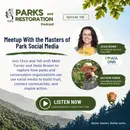
Meetup with the masters of park social media - Jessie Brown & Matt Turner | Episode 106


What if our social media presence was less bulletin board and more of a trust building tool?
The National Park Service and Iowa Department of Natural Resources have developed some of the most recognizable and engaging social media voices in government. But behind the humor, pop culture references, and dad jokes is something much more important: a strategy for building relationships, earning trust, and turning audiences into advocates for conservation.
In this special live episode of Parks and Restoration, recorded with members of the Next Level Leadership Community, Chris Lee and Teli Van Rycke welcome Matt Turner, social media specialist for the National Park Service, and Jessie Brown, award-winning digital strategist for the Iowa DNR.
Together, they explore how parks and conservation agencies can move beyond treating social media as a digital bulletin board and start using it to build genuine connections with their communities.
Key Takeaways
- Relationships come before advocacy. Social media isn't just about attracting visitors. It's about building trust, encouraging outdoor experiences, and ultimately inspiring people to protect the places they love.
- Be human, not bureaucratic. Humor, personality, and authenticity make government agencies more approachable and their messages more memorable.
- You don't need a big budget or professional equipment. A smartphone, a genuine voice, and an understanding of your audience can be more effective than highly polished content.
- Meet criticism with empathy. Negative comments often come from people who care deeply. Listening and responding thoughtfully can turn frustration into understanding and strengthen public trust.
- Empower creativity with clear guardrails. Leaders can give staff room to experiment while maintaining consistency through social media policies, shared expectations, and organizational trust.
- Use AI behind the scenes, not as a substitute for authenticity. AI can help with brainstorming, analyzing performance, and refining ideas, but audiences want real stories and real images from the natural world.
Because better communication builds stronger relationships. And stronger relationships build better parks. Want proof? Check out Episode 7 about Polk County's Two Bond Referendums.
Connect with Our Guests
Matt Turner — Social Media Specialist, National Park Service
Find Matt on LinkedIn.
Jessie Brown — Digital Strategist, Iowa Department of Natural Resources; 2026 Government Social Media Professional of the Year
Find Jessie on LinkedIn.
Join the Next Level Leadership Community
Get invites to future meetups like this one by joining the Next Level Leadership Community at www.parksandrestoration.com.
About Parks & Restoration
Better leaders. Better parks.
Parks and Restoration is a podcast and leadership development platform exploring leadership through the lens of ecology — for the land, via the people who serve it. Each episode is built for current and aspiring leaders in parks, conservation, and natural resources who want practical lessons on culture, growth, impact, and organizational success.
Learn more at www.parksandrestoration.com.
Jessie Brown: The way I've looked at our social media from the beginning is that we're taking people on a journey. It's like a growth journey. And the bottom, the foundation of the pyramid is building relationships and building trust. And then if we've earned that trust and that connection, that relationship when we're posting about parks, different outdoor activities, you know. because we built that trust, they'll they'll believe us, they'll trust us and want to go out into the park. And if we can get them outside, if we can get them in nature, or if they're already, you know, a parkour, we get them fishing now, you know, something along that. The more we get them out there and doing the thing, the more connected they are, and the more that they want to preserve and protect that.
Chris Lee: welcome back to the Parks and Restoration Podcast, the show for parks and natural resource professionals who want to be better leaders for their teams, their communities, and the lands that they steward. I'm your host, Chris Lee. I'm joined today by a whole bunch of people. This is a live webinar with the next level leadership community and followers of the show. I'll be co-hosting here today with Tele Van Rickey, the director of operations here for Parks and Restoration. If you've listened to our recent 100th episode, you know that one of the biggest takeaways over the years is that great parks aren't just built on strategic plans or operational stuff. They're built on relationships, and everything else is downstream of that. Today we're looking at how we build relationships with the millions of people who step foot into our public lands every year or who just have an interest in them. And today we're joined by two incredible people. So I have with me Matt Turner. He's the social media specialist for the National Park Service and the Office of Communications. He's not just a social media consultant who happens to work for the parks, he's a parks professional at his core that evolved into a digital strategist. He arrived in DC in 2018 when the agency's Instagram Sat at about 600,000 followers today, thanks to his work transforming the National Park Service social media voice into one of the most recognizable and entertaining government brands, Fat Bear Week. Anyone? That platform now reaches over 7 million people. And then we also have Jessica or Jesse Brown from the Iowa Department of Natural Resources. She's a highly recognized digital strategist who's been with DNR since way back in 2003, has managed their social media since 2012. She was recently named the 2026 Government Social Media Professional of the Year at the National Golden Post Awards and is widely known for using nineties nostalgia, pop culture, classic Midwestern, my favorite dad jokes to engage millions of people with wildlife conservation. With degrees in journalism and communication studies from the University of Iowa, plus her leadership on the Government Social Media Association member council, she's one of the sharpest voices in public sector communication. Matt, Jesse, welcome to the show. This is going to be fun.
Matt Turner: No, thank you for having us.
Chris Lee: Absolutely. All right, Matt, let's start with you. I want to I'll just jump right into this. In a lot of government circles, whether it's at the county level where I operate or somewhere between the state or the federal level, social media historically gets treated like kind of let's call it an online filing cabinet. Someone writes a formal memo or press release and someone else cuts and pastes it to Facebook. Like here's our information that you need to know, and it's an information clearing house. And that is not your approach. Talk to us about that philosophy shift and How you treat social media as the park service's front door?
Matt Turner: Yeah, for sure. I think a lot of times it can feel like social media is at the bottom of the list or the last step on a comms plan, after the press release or linking to a website, or if you've reached out to reporters, finally you're gonna put something out on social media. And I'm the opposite. I've always thought of social media as the most kind of direct form of communication tool we have for engaging with the public. Like you said, it's like the front door, it's our front yard, for really having an actual conversation with the public and websites, press releases, they can be, you know, kind of static. They are primarily that that kind of one-way form of of communication. But, you know, on the other hand, social media again really gives us that chance to really just invite people into the conversation. We can respond to them, tell it, you or they can certainly respond to us and tell us how they're feeling about a subject in real time. And it gives us a great chance too just to immediately sense, you know, a public's mood, see their questions and I think for us too, we've also seen tremendous engagement by repackaging those more static press releases or memos, make it more digestible for the public. we've leaned in a lot to again that dry humor. We like a lot of dad jokes too, but the witty captions, kind of a a willingness not to take ourselves too seriously all the time. And obviously there's a balance, but there's certainly a time and a place for our humor too. But We just found that can make the MPS feel just a lot more approachable and human and just less bureaucratic, overall.
Chris Lee: Yeah, I this is and I know this is on everybody's mind because this is when I and I I don't get on social media a whole heck of a lot, but when I do and I see National Park Services posts and I'm like, okay, that is not what I'd expect from a federal agency. Like one, did did you just come right out the gate and and with that kind of tongue-in-cheek approach that a lot of it is, or is that something you had to build over time and when did you run into supervisors saying, maybe, maybe tone it back a little bit, Matt, or have you? Like where where has that gone? Because I I know how that is in government circles a lot. It's like, well, you know, we we we can't we can't be too human about this. We're we're we're the government, right? How have you navigated that dynamic?
Matt Turner: Yeah, for sure. I really came in with that strategy of showcasing some personality, some humor. I worked at a lot of smaller parks that social media was really the only way to get a lot of the story out to the general public. So I was always looking for ways to connect with pop culture, with the world around us and try to make those stories resonate for people who might not ever get a chance to visit some of those small parks. So when I had the opportunity to come to DC and headquarters, I really wanted to run with that as well. It wasn't right off the bat. I wanted to test the waters a little bit. So here and there we would start to kind of infuse some of the humor and some of that kind of personality, some of that bluntness, or just kind of I don't like to call it unhinged, what people say in social, but just a little more irreverent in some of our messaging. And I think that's really kind of been the hook that got people's attention, especially when we are trying to communicate around policy issues or a lot of it is the safety messaging. call it our safety with a smile, trying to get people to read through an entire post or to read those steps. And then maybe when they get to a park, they'll have a second thought about approaching that 2,000 pound, you bison. has it worked? I think I feel like bison encounters are down this year, but you know, job security there. But I think for us, definitely the buy-in, you know, it wasn't always easy because we are a hundred-year-old plus agency with a a reputation to kind of uphold we want to certainly not Turn anybody away or off by using, something that might look as irreverent or using humor in a in a not so great way. But for us, I think the buy-in is just seeing the engagement, seeing the positivity, seeing some of those posts with those safety messages get picked up by the media and the press and become their own stories. And then those tips and tricks get shared even wider. And so that messaging is going a lot further than just by posting a pretty static or Or maybe boring memo type or or policy related message. So I think I probably sometimes keep my supervisors up at night, but I mean that's social media in general, right?
Chris Lee: For for sure. Touche, yeah. all right. Jesse's turn now. So just you've expanded the I would and our channels, I think, to hit one million weekly views. Am I accurate on that?
Jessie Brown: In that neighborhood, yeah.
Chris Lee: Just it's insane. Okay. And it's across multiple platforms. So this specific voice, this 90s nostalgia and dad jokes to talk about conservation, where did that tone come from? And how do you maintain that through changing state leadership without getting, you know, again, like the question I asked Matt, like how do you not just lose that voice to the typical government bureaucracy that tends to just water down everything government related?
Jessie Brown: I think Matt and I started from the same standpoint and he's always been a great sort of lighthouse, I guess, for me. you know, I wasn't necessarily super aware you know, from the beginning when I started doing social in 2014. but when Matt really started to hit his stride and starting to look at these posts, and I was like, Okay, yeah, somebody else has taken this and ran with it. And we like, I get him. This is great. it, you know, it's very just makes you feel like, right, I'm on the right track. This is this is working. and from the beginning, like we really didn't know what to expect when we got into social media. we just knew we sort of develop it as we went, but the biggest part was that we needed to sound like we belonged. On social media in the social media community. And we needed to sound like we were Iowans. We needed to sound like we're Midwesterners and we're somebody that you'd bump into in the line at the gas store, gas store, grocery store, or gas station. you know, that that friendly Midwestern small talk kind of friendly, a little disarming. And I think one of our biggest goals in starting to do social was, you know, building trust with people. Building relationships. And that's what gets you there. And so having sort of that sort of safe voice going into it. And dad jokes are like, you know, the safest Midwestern joke you can get, basically. So, you know, just that's sort of how we nudged our way into humor a little bit. And the rest of it is just really how my brain works. it it speaks in nineties pop culture of. references and song lyrics. And Matt has done a great job at that too, especially with parks and recreation references. And the Fat Bear Week post he just did that was totally nine to five rewritten for Fat Bear Week on Dolly Parton Day was excellent. but it's it's that kind of stuff where it's just sounding like you're a person that is in this community, that we're in this outdoors community where we live in the world you live in, you know, let
Matt Turner: Mm-hmm.
Jessie Brown: Let's be friends. and what's kept it going is that it works. thankfully, I mean, really in Iowa in the past 14 years, there hasn't been a ton of political upheaval in terms of different different leadership coming in and out. There's been a lot of consistency. But when we have had change, it's hey, this works. we've sort of developed a reputation where legislators, commissioners, then of course hunters, parkgoers, people who love wildlife, you know, they're giving us all feedback and they like what it is. So don't if it ain't broke, don't fix it, right?
Chris Lee: Right. Yeah. Well, and so, you know, you say it works. And so I want to dig into that a little bit because, you know, we can look at follower count and and you know, going from 600,000 to 7 million followers or, you know, a million views a week or whatever it is. But that's kind of a vanity number in a lot ways. And so what does social media follower growth actually buy an agency? I guess. Like what's the What's the ROI on that and and how do you go about measuring it? You know, because I know a lot of us in in this space, you know, like like we don't have a social media manager here at Des Moines County Conservation. and I know a lot of conservation departments don't, a lot of state agencies don't, a lot of parks departments don't. And so it just kind of falls on whoever is the most active on on social media, like, okay, get on there and post some stuff for us. And that that that's how it works here. I don't know how that's everywhere, but like I I just figure out whoever's the most active in my department. And I'm like, well, you're already on it. Go just post some stuff. And but then I struggle with measuring like, okay, if they're dedicating their time to doing that, let's face it, it's not a small amount of time if you're going to do it well, what what am I getting from it? So you know, I I I I will start with Jesse because she's off mute right now. But I'd like to kind of hear from both of you like what is what is that ROI and and how do you how do you approach that?
Jessie Brown: I'll give you another 90s pop culture reference. The old the old who's line, you know, the rules are made up and points don't matter, is really what social media feels like because the goalposts are changing all the time. The rules are changing all the time, the algorithms change every day practically. so gone are the days where I could do a yearly report and say, next year we're going to increase engagement by 10%. Because Now I don't know. my my reach could be in half next week, but now I'm still successful. It's just everything changed behind the scenes, all the things that I can't control. so in a sense, some of the metrics don't matter, but at the same time, there's definitely stuff you can glean from it where your follower count. I mean, I feel like it's healthy for you know a state of three million. being where we are, not everybody is on Facebook or thing things like that. but if I'm losing a ton of followers, that's a sign to me. If I'm slowly gaining followers, I'm probably doing okay. but I don't know what meta's showing to non-followers this week instead of followers and and that kind of thing. and just making sure things are just sort of stay what seems like a normal thing. but when things don't do what other things have been doing lately or when they're doing a lot more than what posts have done lately, those are the ones to really look at of like what made the successful, what what was different here that maybe it didn't get served in the algorithm or people didn't like it, you know, what what can I learn from that? and so you obviously can't take yourself and compare yourself to National Park Service with a giant following and a giant audience because a city parks and rec department doesn't have the same audience as a federal agency. So really judging and even looking in like other city departments, other par county conservation boards, you know, where are they sort of sitting at? How did they get people interested? you know, talking to others who are doing the same work, especially if it's something that's not in your wheelhouse, you're not, I've got a comms background, so it's in my wheelhouse. But for somebody, who doesn't, you talking to other people who've been doing it for a while, I think is a really great way to figure out what matters and what doesn't. comments, I I love the the feedback from comments and messages. They don't get as much weight in the algorithm anymore. But is that qualitative? You know, it's like, people are connecting with us, they appreciated this, they're asking the right questions, they seem excited about going to this thing, or I think. That's good. And if they're sharing it, that's what's in the algorithm right now. it has value to them. You might not see what they're saying about it, but it has value that they want to share it with people. So it's hard to make a report anymore and say, Hey. but when I do, there's a lot of qualitative stuff in it. Like this is why it was successful. This is why things are working. because it certainly needs that context. because yeah, the rules change every day.
Chris Lee: Matt, what's your take? What's the what's your ROI on all this?
Matt Turner: Pretty much the exact same. It's definitely like the goalpost move every time trying to figure out what all these analytics mean. And on top of that, trying to explain that to higher ups in kind of layman's terms of what an impression is or engagement or reach or like. So we are fortunate on our accounts that we do have kind of a built in fan base as a large kind of federal organization. And so we do look at some of the the likes and the follows as a kind of a broad number, but Again, we're also looking at engagement on individual posts and the number of of shares and like Jesse said, comments and that that type of engagement. What kind of posts get picked up by other media and get turned into stories of their own, that kind of stuff that shows kind of the spread. Or if on Facebook we're directing people to go follow this link to get the rest of the story or to see this article, we can kind of track internally if people are actually going there and clicking to get a sense of huh. that circle of social media and getting it back to our home base is is really working. But but yeah, I think like I said, you know, delivering metrics as always or determining metrics has always been tough. Again, there there's a million analytics out there. What is the best thing you should be tracking or, you know, what makes the most sense. And again, like I said, trying to explain it to those higher ups for them to get more of that buy-in to understand. so I don't like to set arbitrary like goals of, you know, 10% this quarter or We hope to get this many likes and followers, you know, by this time next year. So we really just kind of are going with the flow at this point. We're adding people on again, like Jesse said, as long as we're not losing a great deal of people, or if Instagram's not doing a purge this week of some of their fake profiles, then we're gonna keep doing what we're doing and until that changes. Mm-hmm.
Chris Lee: One of the the things that that triggered what you were talking about this was a level of trust that is is the potential ROI on this. And I have seen I can't cite the statistics or even this this source anymore, but I remember reading, I don't know, this was a while ago, maybe even years now, but that I mean, we know that trust in government is is way, way down right now. But trust in wildlife and conservation agencies is enormous. And I've seen this in my own industry. I don't know if we got anybody on online right now that's from Polk County Conservation, but you know, what was it? The the previous election cycle, they passed their second legacy bond. And so it's a it's a bond that the the people of Polk County voted for. And there's something like 82% of the population there voted to tax themselves more to invest in parks and outdoor recreation and water quality and that kind of stuff just for their own county. And and that's what I've talked about with leaders there in previous episodes. Like, how do you build that level of trust? And and I one of the things that they said was, you know, it's it's the communications that we have and that we're there and that we're accessible and that we're we're humans on the other end of that algorithm there. And I think that's what you two have done an incredible job of is humanizing the thing a little bit, you know, and it's it's it's it's funny and it and it's just it's relatable. And you that it's not just just, some stodgy government person sitting there because they have to. It's like there's a real personality behind this and it's it's a true love for the resource and for the parks. And I think that's that's gotta play a role in it. I don't know how you measure that, but you know, I'm looking at it from a leadership perspective. And if I want to build that recognition of my department at, you know, as a leader and my team here, I I gotta be able to build trust, you know, because let's face it, the It's not like any of our agencies are just raining dollars on us, right? And that that's probably not going to come in future. But if we can build that trust from our communities, whether we're a small, county parks department or or a city parks department or the National Park Service crying out loud, when we need that friends group to rise up to help us out with this thing, or we've got this capital campaign that we're kicking off, we already have that relationship established. And and so I I could see that being, I don't know, like I said, I don't know how you measure that, but I could see that being an immense value to this and and That's kind what I've seen with folks that I've talked to and in prior shows. And so yeah, I think that's that's a really great job that you guys do. So I want to give you kudos on that. So one of the approaches that you guys take is that it's not just recruiting people to come to your park. And a lot of us I I'm guilty of this is okay, let's post some stuff to introduce our parks to the world and maybe we'll get more people to come to our parks because more people in our parks and we can show that there's people coming to our parks. We need the resources that it done, you it's that's the whole budget circle. I feel like you guys do a really great job of going beyond that. And, you know, like like with you, Matt, you talk about safety in the parks. And it's like, okay, once you're here, here's the things you need to be thinking about. You know, don't approach that high-speed assault count. and you do it in a way that that's engaging and and and fun. And Jesse, the the woodcock one, the the the the dance recitals or I can't remember what it was. I thought that was hilarious. What what is your recommendation to parks departments that have are stuck in that mindset of like, you know, we just need to recruit people to our parks. and and how are you coming up with it's it's it's so much more than that. That that change in that messaging, and and creating messages that don't just like tourism promo that don't just look like tourism promotions. No offense to any tourism people, 'cause I know we have on the show here.
Jessie Brown: Back to your rabbit hole of trust. The way I've looked at our social media from the beginning is that we're taking people on a journey. It's like a growth journey. And the bottom, the foundation of the pyramid is building relationships and building trust. And then if we've earned that trust and that connection, that relationship when we're posting about parks, different outdoor activities, you know. because we built that trust, they'll they'll believe us, they'll trust us and want to go out into the park. And if we can get them outside, if we can get them in nature, or if they're already, you know, a parkour, we get them fishing now, you know, something along that. The more we get them out there and doing the thing, the more connected they are, and the more that they want to preserve and protect that. And so by the end, we've taken somebody who either had a fun acronym name for us for DNR because there were there were quite a number when I started 20 years ago. either that level or they just you know had no relationship with us. or just very big. We've taken them from that to now we have advocates, we have people who want to be conservationists, environmentalists, outdoor enthusiasts. And so yeah, it's taking people little bit by bit building those little pieces of trust to get them to that point. and I've also noticed over the years too, along those lines, that some of the things that people were most upset about or asked the most questions about or the most misinformation things, like over time those things have gone way down. And we've had people jumping in our comment sections, explaining it before we can, because of the relationships we built with them already over social. and so that's where a lot of that that ROI is coming. So yes, we want to get people into parks. but yeah, we hope that in doing what we're doing there, we're gonna get them invested in the reason, you know, why why we exist. We're we're there to help protect natural resources and we want them on that journey with us.
Chris Lee: Yeah. So it's that trust thing. Getting in. Matt, how are you?
Matt Turner: Yeah, for years, we had a campaign and a hashtag find your park. And we found people found their park almost too much because especially the big iconic ones were becoming overcrowded and and really at this point we want them to find another park or find another activity. But I think really the goal for us too is not just to get people into the parks, but then to really start just caring about the parks and what's in them, you know, the stories and the places and the wildlife and making that connection to the national park system as a whole and who we are and what we do. And we can go beyond the Yellowstones and the Yosemites. we love those parks. But there's 433 national park sites out there. There's seashores, battlefields, memorials, recreation areas. we confuse everybody by calling them parks, not just the big 63. But so our goal too is to really encourage people to find those lesser known sites or those places you don't haven't heard about. And encourage people to, learn more about those sites. And so yeah, I think our strategy is really just our main account is like a virtual visitor center too. we're here to welcome people, to give them tips and tricks on trip planning, how to stay alive, how to stay safe when they get to those parks, and to kind of be that one stop place for people to learn not just about one park or to tell people to go to this park, but to really just learn about the entire system as a whole and be there as a good resource for all that.
Chris Lee: Yeah. So what I'm hearing is that it it's so it's one thing to in to invite them in, say, hey, come to our park, you know, find your park, whatever that, you know, and and that's great. But it doesn't it doesn't end there because the once they're there, now now you're a resource to them. You know, here here's here's how you don't get mauled by the by the bison. And and here's here's how to optimize your experience. That's building community. And you know, it's like Jesse, like you said, is you got people coming on the comments, answering people's questions for you, that's community. Right. And that's that is a very different thing than just saying, Hey, we're over here, come on over. It's no, it's it's come be part of this thing. That is a very different thing. And I I I love that a lot. Okay, Brian had a question. So let's go ahead and jump to Ryan
Matt Turner: Yeah, just looking for your advice or thoughts about balancing getting it just getting started in social media versus really trying to get it right. Cause there's this learning curve where, the first few videos you watch and you're like, wow, that was terrible that I just produced. so what what do you think about like, is that polluting your brand or is that like fun to to you know bring people on that journey of of kind of production values? And what what advice would you give for for getting started around that? I'll jump in and say I think part of that is part of the process. I think we're always evolving in how we do social, especially as an organization. And I think the biggest thing is when you're putting something out, is then seeing how your audience responds to it. And if they're really enjoying it, I'm sure they'll they might even critique it in the comments themselves or offer some suggestions as social media does. But I think it definitely doesn't hurt to kind of dip the toe in there and test the waters and see again how people are responding and if it makes sense. to continue that route or to tweak things or at the same time continue to look at other accounts or similar, you know, channels out there that that you can maybe find some inspiration from too and see what they're doing and what's tracking with their audience and maybe you can pull some of that into your own stuff.
Jessie Brown: Yeah, and I'll just add to that what Matt said in terms of looking at what others are doing. yeah, make it feel like it fits your audience especially too. So like if you're with a county conservation board, look at other county conservation boards, look at other parks departments, state parks, thing things like that. in terms of just making it right like you're their neighbor. make it feel like it fits, but Don't be overly concerned with that making it look polished. I mean, like don't be grainy, don't be like the wind blowing in your mic the whole time, that kind of rough. But we were fortunate enough to bring on a videographer a couple of years ago, long storied Emmy winning TV news career. And I he's gotten used to me now, but I was like, this is gorgeous. I'm gonna make it really quick and dirty. Sorry, just And he had to like adapt to it. I was like, it's beautiful and it works great for TV, but no, you're you're establishing shot. We've lost everybody because you have like two to three seconds. and so it doesn't have to be super beautiful, high produced. It's just you and your cell phone, as long as it feels like you know, you're you're part of the community, and you're getting good info across You'll just generally build off of that. But yeah, don't think you have to have the most expensive equipment or a whole lighting rig or somebody just use your phone. You'll be okay.
Matt Turner: Thanks for that.
Chris Lee: Yeah. I telly probably has some thoughts on that. Tell you you've seen our stats on social media as far as some of the stuff we've posted from the podcast versus just the videos that I've taken in the couple of times that I've just gone and shot a selfie and I talk about something. Tell talk about that.
Jessie Brown: Yeah, I tell Chris all the time I people just want to get to know him. They want to see the human side of him and make he gets more views than anything that we try to dream up together and, create ourselves. So yeah, he just talks to people on his phone and tells them what he just did and they love it. So I think he needs to keep doing that.
Chris Lee: Yeah, well I think on the last one or one of the few, I had just finished a run. I when I take my boy to soccer practice, I'll do a run around our local recplex and I I I was dripping in sweat huffing and puffing and and you know, I was just a shout out to the park workers that made the place possible. And I I got way more views and and engagements than all of the clips that we've pulled off of the podcast episodes and like I mean, these are really great, thought provoking clips, I think. And and here's some just sweaty dad holding a phone out in front of him and people are like, Yeah, that's what I want to watch. You serious? I don't know, man, the social media stuff.
Jessie Brown: It is crazy. It's hard to believe sometimes.
Chris Lee: Katie's got a really good question here. I f I feel this one. Katie says, How do you not let yourself be affected by comments on social media? Okay, so I'm guilty of this because if if if I do anything on social media, it's like posting ghosts. Like, here's my thing, watch it if you want. I'm out. and this is why I'd have outsourced my social media to people that actually do social media well. So give us your insights on that because I have seen this. I I never read comments. I just I have a rule of life, never ever read the comments. But I know that's important part. So Jesse, you're unmuted right now. Let's let's let's hear your thoughts on the point here.
Jessie Brown: This is a big thing for me. so yeah, it's hard. part of it is we're all in public service. and a tendency of public servants is we're here because we care a lot. And we tend to make our job our whole, you know, it's our, it's who we are. It's what we do. so this is my work, and you're saying something really mean. So it's easy to take personal, but The thing that I always go back to is here we go again with another reference. Leslie Nope, you know, being at the public meeting, and when people are yelling, I just hear people caring loudly, right? They're caring loudly at me. And when you take a step back and start looking through some of the comments, it it's evident that some people are maybe not the most polite or articulate. in this, but they're saying the things they're saying because they care a whole lot about something. and it's getting sort of to the root of, okay, what is the thing that's upsetting you? and how can I sort of meet that with empathy? And it's it's a leap because they just said something really mean about you. But they're all generally opportunities because most people who are saying that kind of stuff on social don't expect you to respond. They're just saying it to get it out there or Or they think because you're government, you won't respond. So sometimes just responding is enough just to disarm them. And then you get past that emotional spot because the way humans are wired is that emotion comes first. Emotion is automatic. We don't control, you know, when we get angry. We get angry and then we go, I'm angry. I should calm down or I'm gonna lean into it. We don't we don't control getting angry. That just happens. So we can't beat emotion with logic. So we gotta meet emotion with empathy first. And then you can have the conversation. Then you can hit them with the facts. Maybe we don't get to that person either. but generally, if you're in a comment section, you could have hundreds, thousands of other people reading that. And you might not get that one person that was upset, but you've convinced 700 other people that, yeah, they know what they're doing. This is why they did that thing. Or in Matt's case, millions of people saying it. and being able to have those opportunities where you sort of do turn people or get them to understand what's going on, that makes all the future negative comments a little bit easier because you know you can you can get through it. but while it feels super personal, generally it's just easy to remember. Well, it's not easy to remember, but it's important to remember that generally again. They're just really passionate about something and it's saying more about them and what's going on with them that they're saying it in this way. it's generally not about you personally. Sometimes it's not even about your agency. So but the other thing I will say is it's easy to ignore them. Sorry, Chris. but
Chris Lee: No I
Jessie Brown: when you're speaking as the agency, especially, that sometimes speaks a lot louder than a response does, because No, they don't care. They don't respond to me. They, it can it can make things even worse. Then the conspiracy theories get even bigger about why you're not saying anything. So generally there are a few things that you maybe you don't need to respond to, but I think it's important.
Matt Turner: Yeah, I'd say, engagement's engagement. So the more comments, that helps. But I think I learned early on to let things roll away and know that people are mainly commenting about the organization, not necessarily the person behind the screen doing it. Although there are those comments about, you know, you need to fire that intern. And I'm like, more upset they're calling me an intern than but I think there also can be, a thousand positive comments and I'm gonna center in on that negative one. That's gonna kinda eat me a little bit. But I think like Jesse was saying, we only respond back if it makes sense to to correct misinformation, or you can tell if there's a more playful comment or banter that can be had as an agency, but for the most part, we're not gonna jump in or try to have a mic drop moment or try to become too sassy or things like that, because that can become off as unprofessional and Grow things bigger and bigger. And so for the most part, we just look at the comments, see what we can learn from them again, sense the mood of the audience. If it's more general, I mean, we're a federal agency. people think we have a direct land to the White House. So they'll post anything on our platforms as these public forums. But otherwise, you know, there can be some controversial policy issues or things that are happening in the world or in government, and people will come to the our platforms to let us know that as well. But again, that's what we signed up for. I think if you're not getting negative comments on social, are you really doing social? so I think we always kind of just try to to make sure that we're keeping an eye and an ear to what's going on and and monitoring as best we can, but never let things become personal. So I think that's kind of our motto is not to take things personal as social media managers for the Park Service and just to c continue moving forward and And again, I I love the Leslie Note quote, that's a great scene because I feel like I I like that meme quite a bit and I wanna use that all the time when responding to just friends and family of what you have to deal with on a daily basis.
Chris Lee: Yeah. I I I like that. that's good insight of you they they just they're caring very loudly. And and and and you're right, it's sometimes it is and you know, and like I guess I look at it from the perspective of when somebody from the public comes to me, you know, not even via social media and they're they're mad about something or they're passionate about something, and and it's you know potentially controversial. Sometimes they just want to be heard. And and so to your point of just responding to it, wow, there there is a human on the other end of this. I that that's good. Yeah. And I'm not saying that posting and ghosting is the right thing to do. I just, you know, that's why I don't run the social media is because that's that was my philosophy and then I saw how it didn't work. Okay. Let's let's bring this practical application here. So let's say I'm a naturalist or a park tech for a county conservation board or a small parks department, municipal parks department. nobody hired me to do social media, but I'm I'm I'm active on social media. So Chris dumped it on my desk. I've got no budget, no training, no time. What's the first three things I should do to be remotely successful in this in this endeavor?
Jessie Brown: Scream and run. I
Chris Lee: Yes.
Jessie Brown: Yeah, it it's overwhelming, especially if there isn't already an established social presence. Like if you're growing this from zero, that's that is a tall task in social media today. But we've mentioned it already a few times is really just see what other agencies like your own are doing already. you know, how often they're posting what kind of stuff, what seems to be working or Maybe it's something that's not working, but it gives you an idea of if I was promoting that, maybe I'd do it this way. but yeah, just see what you know, kind of stuff they're doing. And if you have any like folks within your agency, like since county conservation boards do a lot of naturalist stuff, you've already had a lot of contact with people who are interested in this stuff, right? So sort of pick some brains about like what kind of stuff would you want to see from us? Like What do you what do you want to hear from us? What do you want to know? So think your audience and figure out who do I need to reach and what kind of stuff do they want to see? and yeah, see what works well, see who's running those accounts. A lot of times, you know, there's like county conservation boards have an association, Parks and Rec have an association, you know, find out who the other social people are and get together and talk. I've got a meetup I have with other state of Iowa social leads. Matt and I have both been involved with Association for Conservation Information. So that's state fish and game agencies and some federal mostly. And then government social media association. I have to, I have to plug GSM as well. But generally the biggest value, you'll get some education, but it's the people that you meet who are doing the work that you're doing and being able to troubleshoot pick each other's brains. So find the people who are already doing it and Like I've said before, just, act like somebody who is part of your audience, who lives there, loves the things they love, which would be the outdoors, right? and just lean into that.
Chris Lee: Yeah. Good. Matt?
Matt Turner: Yeah, s along the same lines. I think what get one of those stickers that says don't panic and then
Chris Lee: Yeah.
Matt Turner: panic internally. But I think a lot of it's kind of what Jesse was saying, you know, what do want to see on social? What do you kind of things you gravitate towards that would make sense to share to the the wider community? And I think too also knowing that you're not alone. There are all these kind of organizations out there that can help and guidance, but also you're not alone in that kind of we're all in the same boat. Like We're the National Park Service. We don't have a budget for social. We don't do marketing or ads. So we're a small team. So we don't have all the bells and whistles that say a commercial or another outside brand was had. So I think especially for government agencies, definitely kind of look for those similar channels or people that you can reach out or that you feel comfortable even just sending an email and connecting through, you know, LinkedIn or something and asking questions like, How do you do that? Or how did you get started with that? Or do you have any recommendations? And And then I think above all, just again, dip your toe in there and then start listening to your audience, seeing what they're responding to, and start to build that community. And I think definitely it'll continue to hopefully grow from there.
Chris Lee: Yeah, yeah, I like that. So I wanna put my leader hat on and come at this from exactly what I was asking people not to do earlier. But so a a real example here over the the summer we had an intern, very young intern is active on all the socials and stuff. And so she would do these these videos and they were they were super popular, people loved them. And you know, I'm like, that's great. And then one day she walks into my office, she says, hey, we have a TikTok account now. And I'm like, We have a what? none of this was run by me as the boss or anything. And I'm like, I don't I don't know that I I even want us on TikTok at this juncture. But it it was fine. She had worked with our our nature center manager who's really in charge of our social media and everything. So it was, she didn't do anything wrong. But it got me to thinking, and that was one of the questions I want to ask here, what are the guardrails that that lets a leader sleep at night? without putting my thumb on the enthusiasm of the people that are wanting to run with this and are having some success with it. I mean, some of the videos she did was just absolutely incredible. And, you know, I mean, and she could she could knock them out in minutes. You know, she just she'd run around the nature center and shoot little clips and then all of a sudden it was this it was this hilarious TikTok video. And I'm like, I don't I don't even know how you how you did this. Like you did this in the time it took me to answer an email. And so like I don't want to squash that, but I've got real concerns. And so like as leaders, how do we strike that balance and and what would be your recommendations? Maybe, you know, maybe where you've seen a leader take it too far towards the controlling side or or maybe not enough? Give me your take on that. Yeah.
Matt Turner: First off, I'd say we're TikTok's a whole nother discussion we could have. Park Service is not on TikTok. You will see a lot of we we made some news with people making thirst traps on TikToks for the national parks, but that was not me. But I think definitely as far as getting people involved and starting new platforms and getting in social media, I think starting small, but letting those people who have that interest and the knowledge, giving them kind of ownership. and some guidance around, having a channel and let them experiment and see what kind of resonates. And then you're learning from what's working, maybe what's not working. And then you can kind of take that back to to your leadership to kind of see if this is something you want to kind of expand upon or, you know, we tried it, didn't work. Let's try this over here. But I think just giving kind of that latitude really just allows for some creativity. And o of oftentimes that's where the best things happen, I think, in social is when some of those guardrails are kind of stripped away. I think that's what's worked for the Park Service and that we you know, I a lot of government agencies that have to get every photograph approved, every emoji, every like, every comment or response approved. And we've really not had to go that route, knock on wood, to make sure that we were able 'cause we were hired in this job to do the job and we were told, this is what we're we're gonna do. And we have the experience to navigate to those channels without having to bother leadership or get that leadership approval every time. So I think over time they're gonna have that trust in what you've you've created and again, that's gonna allow for more of that trust to build and and maybe you'll create more more accounts out there.
Jessie Brown: Yeah, Matt Matt nailed it. It's it's really about trust both ways and empowering them to use the expertise that they have or the the creativity that they have. but I understand from a leadership perspective of like you know how how loose of a leash is it. and I've been fortunate, like Matt, to have a lot of creative freedom and not need everything approved. But I will say having like a social media policy a benchmarks guidebook kind of thing can be helpful and then you know you can sign off on that and for for us it's 30 pages i'm I'm sure it's enthralling reading
Chris Lee: But that'll help the leader sleep at night. Yeah.
Jessie Brown: It might put them to sleep. but it it gets into some, you know, the legal stuff you have to acknowledge with social media. But for the most part, like ours is it defines our voice and how we talk. It defines how we talk on different platforms and the kinds of content that's most popular. you know, like hunting is great on Instagram and you know, parks are too, but more be more on threads. They love parks, you know. It puts a lot of that in there to help them if you do have interns coming in or you have staff changing, it'll help with consistency to, it gives them idea of, this is, you know, sort of the realm that I have, the sandbox I have to play in. but it also covers stuff like accessibility. So, you know, those are important things to make sure people, especially in government, are following all your accessibility standards and requirements. And it lays all that stuff out so you don't have to be concerned with that. but it it
Chris Lee: And there's new regulation coming on that too. Coming down the path. Yeah.
Jessie Brown: and and it's good to also if you have you know, people inside the agency, maybe who are like, post this thing, you know, a PDF or a memo, whatever. You know, the things that you're saying at the beginning. that guidebook will say, This is why we don't do that, this is why we don't use AI flyers, this is why, you know, and it's already lined out and it's been approved by leadership. So it's a little bit more effective way of saying. Can we try something else? I
Chris Lee: Mm-hmm.
Jessie Brown: was hoping you could tell me a little bit more about what you were just saying about the AI. I think a lot of us here are not trained in social media and communications. And so we turn to AI for some help. And so I was wondering if Matt and Jesse, Jesse, you're unmuted first. how do you or what is advice that you would give to park leaders, conservation, nonprofit leaders on using AI to help with their social media in today's world? There's lots of stuff you can do to with AI in the background to understand gain insights from the metrics we were talking about earlier. Like you download past three months of Facebook post performance data and ask your AI like, what were the themes and the post types and this and this and this that did best? So you know that it was short form video about fishing in this park or something. it'll help. speed that stuff up. It'll help with brainstorming, things like that. But we know AI is not always accurate. So it's a good starting point, but you always have to fact check it. in terms of image generation, I highly recommend not doing that just because our followers, our audiences, do not like it. They they can see it a mile away and they don't want it. And then your post becomes all about you using AI instead of whatever the thing is that you were trying to get across to people. so there are lots of ways to use it. I just wouldn't use it to create your content. Awesome. Those are great ways to use it. I jotted them down real fast. Thank you. What about you, Matt?
Matt Turner: Yeah, just like you said, I'm I'm a lot more internal. I love a good grammar check. going through, you know, the resources that come from our websites too and run those through to see what to to pull from. But again, we try to avoid images, especially. You know, people come to the park service expecting amazing images of parks and of wildlife. And they can definitely tell. They can tell when a photographer has manipulated an image for like a night sky or anything. Through more traditional ways of that, let alone AI. And so I know our team is really cracked down on a lot of parks creating AI generated flyers or scheduling and things like that because it is very noticeable. And that takes away from the park itself when people think, well, they don't need a social media manager or they don't need extra rangers, or they're just gonna put things in AI and generate it for them. So I think for us, it we really want to stay that more traditional. route by using the images provided to us by the real world and and definitely, you know, use it where it makes sense. But again, a lot more kind of the behind the scenes. sometimes it's unfortunate when people automatically think our posts are written by AI because they are a little more irreverent sometimes or they don't you know, sometimes we do put in a typo there just to see if people are paying attention. but otherwise I think you know, like Jesse said, there's there's a good time and a place for using it. But for us we're very cautious. the government, we're gonna wait a few years to see if it's, gonna work for for us. But we'll see.
Jessie Brown: I really like that. Thank you. I'll just add to the nature of our agencies, both the environmental concerns with AI generation, also sort of reflect back, you know, with our certain type of agency. DNR especially, you know, we're environmental and conservation recreation. that's that's a red flag to a lot of people. So what I'm hearing is as a leader, you definitely need to implement a policy of some kind, for sure. Yep.
Chris Lee: Well and I mean and Telly and I have have debated this a little bit on like AI is the wild west right now. And and I I'd I I really want to do a webinar like this about about AI and and you know, what it's good for and what is not and what, you know, maybe it could be used for or ought not to be, but we won't dig into it too terribly much right here. But I think you guys bring really great insight into that. and I I hadn't even really thought about the conservation aspect of, just the the environmental impacts that that cranking all that data has. and Lord knows data centers are all the all the rage right now, certainly here in Iowa, but probably across the across the world. Jessica asked the question, how do you both come up with your hilarious ideas and jokes? And and that was a question I had too. Like, how do you sustain that content that like I I I c I could see somebody doing this for a little bit of time and and you only got so much content. How do you how do you keep the the content machine cranking out such great stuff?
Matt Turner: Honestly, I'd say for me, a lot of it, you're gonna be seeing what I'm watching on TV probably or what I'm following in the world because I'm gonna pull from references from some of my traditional, you know, favorite resources. But again, just kind of seeing some of the trends out there. I'm always looking for ways that we can repackage a trend or something viral or a meme to fit the park service kind of story. And it doesn't always work that way. So we move on by that one. But I always just seeing what ways we can connect in a in a meaningful way and And hopefully add some some humor or some wit into it. but it's not always easy. I feel like there's lots of times when I have that kind of as I guess it's not writer's block, but just that social media block. And I'm like, I don't have anything today. So or maybe I'll find a cool picture and I'll try to figure out something to pair with it, but I can't do it, vice versa. Or I have a good idea for a caption, but I can't find that right photo to to match what I'm trying to to put out there. So sometimes I'll sit on that for for a while and then maybe something will come to me. Down the line, I'll remember it. But yeah, I think a lot of it is just trying to be inspired by the world around us. And I've come up through the park service. So I do pull a lot of stuff already from my experience being a frontline ranger and dealing with visitors and giving tours and seeing wildlife. And I've done pretty much probably every job there is in the park service. So I'm definitely trying to reach into that bag to try to, you know, figure out what I can talk about that would make sense for someone on a trip or someone going on a tour or Doing customer service, that kind of stuff. or just people being on a trip and remembering one of the first things I was told when I started working the park service was to remember that people visiting parks are on their vacation and probably have turned off part of their brain. So I kind of take that into our kind of safety messaging and type of kind of philosophy and how we can make those more streamlined blunt one liners and things like that that just get people's attention and then we can kind of dive into the rest of the story. But I think Some of those, people do find the humor in that.
Jessie Brown: Yeah. Yeah, I can't tell you how I come up with stuff. It's just it's just how I'm wired. I heard Kellis' song Milkshake one day and I think I'd seen a picture of a milk snake two days before and I went, my milk snake brings all the rodents to the yard. And I'm like, there it is. it's it's stuff like that. It's just like I don't It just happens. but I will say, w when lightning doesn't strike like that, I do have email set up from Google Trends. So I think it's maybe like once or twice a week. It'll tell you what people are searching in different in the US. you can do it by state, things like that. So you sort of know what people are talking about. If it's, you know, like, this might be something that I could do something with. But otherwise, after yeah, doing this for 14 years, it is like, yeah, how how do we keep this fresh? But there's just so much stuff for us that's cyclical. I mean, like I know I got ice fishing every winter, I know I've got deer gun seasons every fall. I you know, so I know things are coming. And I've also have content that's done really well over the past 14 years. So not everybody, you know, on social media has seen it. So if I post it again, it could be a whole new audience. May I can change a few words, change the approach this time, but I can still take the basic facts, repackage it, and you know, no one knows the better. I did have one person call us out once on Twitter back in the day because I reused a tweet and I just said, Well, hey, we're an environmental eng agency, we like recycling. So
Chris Lee: Yeah.
Jessie Brown: that worked. But
Chris Lee: Even the response is gold. my gosh.
Jessie Brown: But yeah, things work well. Do use it again.
Chris Lee: No how. And so what I'm hearing there is is it's just constantly having that lens on of just filtering life through the lens of how could this apply to social media. And I know, you know, I do this with like how could this apply to the through the lens of leadership? And and you know, it's it's it's kind of astounding the the way things will just kind of present themselves to you. And so a lot of the analogies that I talk about on the show or in some of my talks is just by having that your eyes open to, okay, you know, this is just the lens that I'm trying to see the world through. And and when you're when you're intentional about doing that, then then you get some of that. It's that's that's cool. But I don't know. It sounds like they just put the right people in the right positions there. Cause I certainly couldn't do it. Okay. I always end with this question, and it is If you could give one message to listeners or to the parks and conservation world in general, whether it be about social media or it could be anything, one key takeaway, what would that be? So Matt, let's start with you.
Matt Turner: I think my go-to is just don't pet the fluffy cows. but also for social, I think my mantra has always been just never post to post. I think we're always striving to really just share meaningful content with the world, not just content to check a box. So I think that's always something that we try to to live by and and make sure that everything we're putting out there has some value in it. And so that's why I always recommend to people.
Jessie Brown: Yeah. Just have fun and act like a person.
Chris Lee: That's that yeah, that's great. Well, Desse, Matt, and everybody else on the show, thank you guys for joining us. If folks wanted to get in touch with you, where's the best way or best way for them to do so.
Jessie Brown: LinkedIn for me, probably.
Chris Lee: Okay.
Matt Turner: Yeah, probably LinkedIn. I'm not on TikTok. My cat is, but I'm not really receiving messages there.
Chris Lee: Right on. All right. And I will post the links to that when we post this episode. It'll be in the show notes. So guys, thank you so much. And for everybody that tuned in, thank you. And when this posts, for everybody listening, thank you for what you do. And like Jesse said, just be a person on the other end of that posting and don't post something just to post. Actually put out good content and that will make the world a better place, I do believe. So thank you all and We will talk to you again soon. Take care. Wait, wait, wait. Don't go yet. Don't start that next episode. I've got something for you. The Parks and Restoration Better Meetings Field Guide. See, most meetings just suck. And I'm going to wage war on crappy meetings. Go to parksandrestoration.com, enter your email into the next level leadership community mailing list, and you'll get access to the free PDF download, which is the Better Meetings field guide. It will walk you through what meetings to get rid of, how to make the standing meetings better, and just all around get things done and not just sit there twiddling your thumbs and wondering why. Did I get myself into this? The Better Meetings Field Guide from Parks and Restoration. Go to parksandrestoration.com, join the next level leadership community, get the download. See you at the next episode. Take care.


